
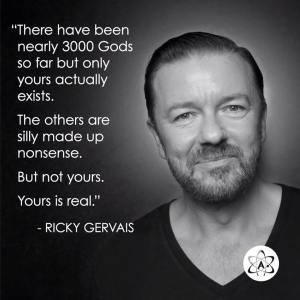
I have a long history of being annoyed by Ricky Gervais, going back way before I saw this meme — but only in his chosen context as a commentator on religion, not his animal rights activism nor his show business persona. I think he’s a comic genius, and I have always loved his work on programs like “The Office” and “Derek.” I wish he would stick to that and stop belittling good, genuine people with his blanket mockery of religion. His approach is confrontational and competitive, and doesn’t advance the conversation much.
Taken by itself, removed from the context of New Atheism of which he is one of the louder, higher-profile spokespersons, his rhetoric is appropriate enough for the majority of believers who know there is something not right about exclusivity and already have space in their intellect for a good wedge to be inserted. But these are the people most likely to advance religious concepts beyond literalism through progressive influences like pantheism, and he’s encouraging them to give up the game entirely. But these aren’t the jihadists or science deniers; they don’t constitute the clear and present danger of religion. It is fundamentalists who will hear his message as a threat, reject it and become all the more convinced that the secular humanist world is an abomination. In all cases, confrontation is just not a good strategy for reaching religious folks of any ilk.
But that isn’t what makes Ricky Gervais an intellectually stifling danger in his own right. It is his extreme positivist belief that all beliefs are wrong, and that only a nitwit would entertain any of them. Self-contradiction is one thing, and hardly unique to New Atheists. It is the trademark snarky air of superiority that makes them uniquely annoying. To wit:
Actually, Ricky, every one of those 3,000 deities (some would prefer to be called goddesses) are very real, man-made portals to aspects of a Oneness of being that the human brain, operating in the fog of its self-imposed isolation, is otherwise too limited in scope to comprehend. This is an important psychological function that has the potential to snap us out of the mental claustrophobia that results from labeling things “silly” or “nonsense” or “Ricky Gervais” and thinking that you have defined them through this labeling. That is called fundamentalism, which is the essence of what distorts Reality into fiction, Nature into the subnatural.
Every one of those 3,000 deities is a metaphor, either for Nature itself or an aspect thereof. A metaphor is an acknowledgment that Reality cannot be contained by our labels, but that it can be pointed toward, in a way that draws attention to it but preserves the ability for direct experience of Reality itself. You cannot grasp the moon and hold it and share it with others as your possession. But you can point to it, drawing the attention of others, letting them experience it on their own terms or simply gaze and lose themselves in the union of seer and Seen. In the words of someone who put a lot more thought into this than you have:
“Mythology is not a lie. Mythology is poetry, it is metaphorical. It has been well said that mythology is the penultimate truth–penultimate because the ultimate cannot be put into words. It is beyond words. Beyond images, beyond that bounding rim of the Buddhist Wheel of Becoming. Mythology pitches the mind beyond that rim, to what can be known but not told.” —Joseph Campbell
Omniperennialism, on the other hand, is the study of the world’s mythological constructs — not excluding secular philosophy and the findings of science — as a collective, singular phenomenon with many modes of expression. Its relativism is like that of the multilinguist who comes to see that language only points us toward direct experience of the thing-in-itself we call Reality, and that there are many ways to point to the same Reality.
By showing us that asking “what is the right religion” is no different than asking “what is the right language,” the 3,000 deities allow us the whole resplendent variety of metaphorical languages and images with which to pitch our minds beyond the edge of any subnatural overlay created by human culture, into what can be known but not told — Reality itself. This is the key to progressing beyond mere tolerance of cultural differences (which always invites intolerance when the going gets rough) and into actual transcultural understanding and collaboration.
But you, Ricky — you fear religion so much that you would have us all become illiterate mutes, devoid of any choices for metaphorical language, capable of understanding Reality on only one level — which, not so coincidentally, is your own. Hmmmm….closet fundie much?
We agree on one thing: that there is a lot of danger in believing exclusively in one deity and rejecting the 2,999 others as silly made up nonsense. But how is that different than accepting only one view of Reality and rejecting 3,000 others? That’s a step backwards intellectually, my friend.
Fundamentalism obviously isn’t limited to religion (cuz if you go carrying pictures of Chairman Mao, you ain’t gonna make it with anyone anyhow). What we need to make the world a more harmonious and wise place is a revolution, not just in what we think, but far more in the way we think –a sharp turn away from the fundamentalism that wants to dominate not just what other people experience, but to define how they experience Reality. Religion can be an extremely useful and dynamic teaching tool. If we learn about how to use it properly and educate ourselves about its metaphorical power, it actually functions simultaneously on many levels with various entry points (making it more democratic than most social institutions) and can point us in a direction away from the subnatural, fundamentalist mindset that has dogged us since we started trying to cram Reality into words.
Ah, but you get more laughs by making fun of others who aren’t as smart as you. Got it. Carry on, then. We’ll just hang out on the same plane indefinitely, butchering each other over which of the 3,001 gods is real. Allahu Akbar!


Leave a comment